

At DiStefano Hair Restoration Center, one question comes up almost daily:
“Do you offer hair implants for men?”
It’s not the wrong question — it’s just the wrong word.
In everyday conversation, implants sounds advanced. Permanent. High-tech. In medicine, however, the word carries a very specific meaning: the insertion of foreign material into living tissue. And when we’re talking about the scalp — a vascular, immune-active structure with follicles embedded deep in the dermis — that distinction matters.
Here is the core medical reality:
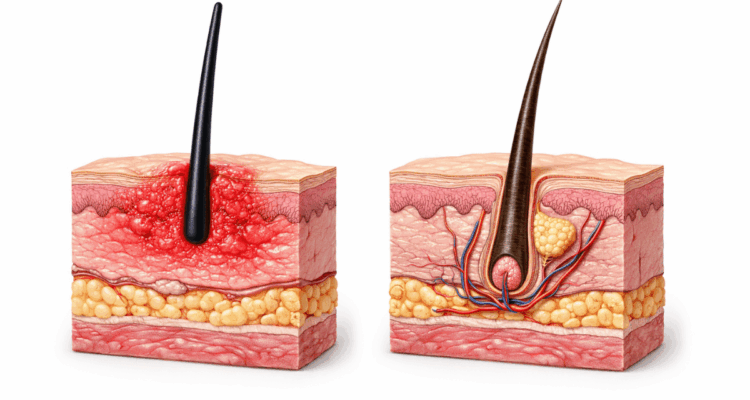
Hair transplants succeed because they relocate living follicular units that reconnect to blood supply. Synthetic hair “implants” fail because they introduce foreign fibers that cannot biologically integrate — and may trigger inflammation, infection, and permanent scarring.
Understanding that difference can protect both your hair and your long-term scalp health.
Why “Hair Implants” Is a Misleading Term
When men search for “hair implants,” they are usually trying to solve something emotional, not anatomical — the fear of looking older or visibly thinning.
Unfortunately, marketing language often ignores biology.
A natural hair follicle is not just a strand of hair. It is a mini-organ. Each follicle contains:
-
A dermal papilla (the growth command center)
-
Epithelial stem cell niches
-
Sebaceous glands
-
Connective tissue
-
A surrounding microvascular network
This entire structure lives within the dermis and depends on continuous oxygen and nutrient delivery through capillaries.
Synthetic fibers contain none of this.
They have:
-
No dermal papilla
-
No stem cells
-
No ability to produce keratin
-
No hair cycle (anagen, catagen, telogen)
They are simply manufactured material inserted into immune-active tissue.
When foreign fibers enter the dermis, the body may respond defensively. That reaction can include:
-
Chronic inflammation
-
Persistent folliculitis-like bumps
-
Drainage or tenderness
-
Progressive scarring that damages native follicles
The terminology matters. A transplant moves living tissue. An implant inserts foreign material. The medical risk profiles are entirely different.
The Real Safety Difference: Vascularization
The reason modern hair transplantation is safe and durable comes down to one biological process:
Revascularization.
When a follicular unit is transplanted, it is still living tissue. After placement, it reconnects to the scalp’s blood supply through angiogenesis — the formation of new capillaries around the graft.
Once vascularized, the follicle survives, cycles normally, and produces hair permanently.
Synthetic fibers cannot vascularize. They are biologically inert. The body must either wall them off with fibrotic tissue or attempt to expel them.
In some patients, that immune activity escalates into:
-
Chronic inflammation
-
Recurrent infection
-
Dermal scarring
This is not theoretical. In the United States, synthetic hair fiber implantation has been prohibited under FDA enforcement since the early 1980s due to documented safety concerns, including infection and adverse tissue reactions.
That is why reputable U.S. clinics focus exclusively on biologic transplantation.
At DiStefano, our position is clear: we do not place foreign fibers into the scalp. We restore hair using your own living follicles — nothing artificial.
What a Hair Transplant Actually Moves
A hair transplant does not move “hair.” It relocates follicular units.
Each follicular unit is a complete biological structure embedded deep within the dermis, containing:
-
One to four hairs
-
Dermal papilla
-
Sebaceous glands
-
Supportive connective tissue
-
Microvascular components
The dermal papilla regulates hair thickness, growth cycling, and long-term regeneration. As long as this structure remains intact, the follicle retains the ability to produce hair indefinitely.
The scientific principle that makes transplantation work is called donor dominance. Follicles taken from the permanent donor zone are genetically resistant to DHT (dihydrotestosterone). When relocated to thinning areas, they retain that resistance.
In other words, they keep behaving like donor hair — even in a new location.
After implantation:
-
Grafts enter a brief resting phase.
-
Angiogenesis reconnects them to blood supply.
-
Normal hair cycling resumes.
This is living biology — not cosmetic camouflage.
At DiStefano, graft survival is protected through:
-
Minimal ischemic time
-
Continuous hydration
-
Precise angulation
-
Controlled recipient density
Technique directly determines outcome.
Why Synthetic Fibers Cannot Replicate Biology
Synthetic fibers lack every structure necessary for integration.
They cannot:
-
Reconnect to blood supply
-
Participate in the hair cycle
-
Regenerate after shedding
-
Adapt to scalp aging
Because they cannot vascularize, the dermis must mount a defensive response. That can lead to:
-
Fibrotic encapsulation
-
Chronic immune activation
-
Recurrent infections
-
Scarring alopecia
Another critical limitation: permanence.
Synthetic fibers do not grow. If they shed, fracture, or require removal due to infection, they are permanently lost unless another invasive insertion is performed. Each additional session increases cumulative tissue trauma and may reduce scalp blood flow.
This biological mismatch is precisely why synthetic implantation does not meet U.S. medical standards.
At DiStefano, we follow one rule:
Living tissue belongs in living tissue.
The Critical Window: 48–72 Hours After Surgery
The success of a hair transplant is determined before visible growth begins.
In the first 48–72 hours:
-
Grafts survive temporarily through passive diffusion.
-
New capillaries form around them.
-
Permanent integration occurs.
If recipient sites are overly dense or poorly designed, blood flow may be compromised. That can reduce graft survival.
Our surgical planning prioritizes:
-
Preserving dermal blood supply
-
Strategic spacing
-
Physiologic density
-
Natural angulation
This is why transplanted hair behaves normally. Once vascularized, it grows, cycles, and responds to grooming just like the rest of your hair.
Why Reputable U.S. Clinics Reject “Implants”
Hair restoration in the United States is governed by medical ethics, not marketing language.
Any procedure must demonstrate that its benefits outweigh its risks.
Synthetic fiber implantation does not meet that standard.
The FDA prohibition reflects documented complications — including infection and irreversible scarring. Offering such procedures would violate professional responsibility.
At DiStefano Hair Restoration Center, we view hair restoration as reconstructive medicine, not a cosmetic experiment. That perspective guides our refusal to offer synthetic implants, regardless of demand.
Our Biology-First Approach
The scalp is not a passive surface. It is layered, vascular, elastic, and biologically dynamic.
Our approach accounts for:
-
Scalp blood supply
-
Tissue elasticity
-
Follicular orientation
-
Long-term hair loss progression
Hair loss is progressive. A successful transplant must look natural not only today, but decades from now.
By working exclusively with living follicular units, we ensure that transplanted hair integrates, grows, and ages naturally with the patient.
Predictable. Stable. Medically sound.
The Bottom Line
The difference between hair implants and hair transplants is not semantic.
It is biological.
Hair implants rely on foreign fibers that cannot vascularize, cannot grow, and may provoke immune damage.
Hair transplants relocate living follicles that reconnect to blood supply and continue producing hair permanently.
At DiStefano Hair Restoration Center, we believe patients deserve clarity and evidence-based solutions.
If you are considering treatment, the most important step is understanding your real options — grounded in biology, not buzzwords.
Let’s have that conversation.