
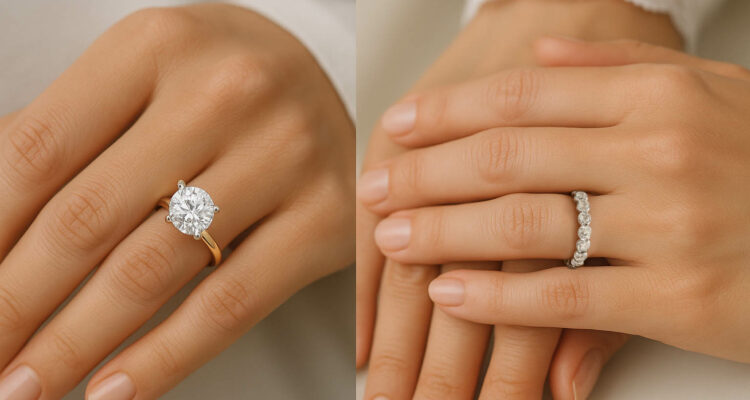

Few pieces of jewellery carry as much meaning as the rings exchanged on the journey to marriage. They represent love, commitment, intention, and lifelong partnership. Yet one question continues to come up again and again:
What exactly is the difference between an engagement ring and a wedding ring?
Search terms like engagement ring vs wedding ring, engagement vs wedding ring, and wedding band vs engagement ring are incredibly popular because the distinction goes far beyond appearance. It touches on timing, symbolism, tradition, and personal expression.
Let’s break it down clearly and thoughtfully so you can choose with confidence.
Why Is There So Much Confusion?
Part of the confusion comes from cultural history.
Not every tradition originally used two rings. In many parts of India, marriage was symbolised through other sacred items like the mangalsutra, toe rings, or bangles. In several cultures worldwide, couples historically exchanged only one ring — or none at all.
Western traditions later formalised a two-ring system:
-
Engagement ring at the proposal
-
Wedding ring during the ceremony
As cultures blended and global influences increased, the lines between the two became less rigid. Add modern jewellery trends and social media styling, and it’s easy to see why many people aren’t sure where one ring ends and the other begins.
Understanding their purpose helps clarify everything.
What Is an Engagement Ring?
An engagement ring is given at the time of a proposal. It symbolises a promise — the intention to marry.
It is the beginning of the journey.
Key Characteristics:
-
Typically features a prominent diamond or gemstone
-
Designed to stand out
-
Worn before marriage
-
Often chosen as a surprise (though many couples now choose together)
In simple terms, the engagement ring announces the decision:
“We are going to be married.”
It’s the emotional statement piece — bold, celebratory, and deeply symbolic.
A Short History of the Engagement Ring
The first recorded diamond engagement ring dates back to 1477, when Archduke Maximilian of Austria proposed with one. Diamonds were selected not merely for beauty, but for symbolism — strength, clarity, and permanence.
In India, engagement rings gained widespread popularity much later. Over time, they blended seamlessly with the country’s deep appreciation for meaningful jewellery.
Today, engagement rings reflect personal taste just as much as tradition — from classic solitaires to intricate contemporary designs.
What Is a Wedding Ring (Wedding Band)?
A wedding ring, often called a wedding band, is exchanged during the wedding ceremony itself. It symbolises commitment fulfilled.
While the engagement ring represents a promise, the wedding ring represents the vow.
Key Characteristics:
-
Usually simpler in design
-
Often a plain band or subtle diamond setting
-
Designed for daily, long-term wear
-
Typically exchanged by both partners
In the wedding band vs engagement ring comparison, the wedding band may appear more understated — but its meaning runs deep.
It quietly says:
“We are now married.”
The Origins of the Wedding Band
The wedding band dates back to ancient Egypt. The circular shape symbolised eternity — no beginning and no end.
The Romans later adopted the tradition and believed that the fourth finger of the left hand contained a vein directly connected to the heart (the “vena amoris”).
In Indian traditions, lifelong commitment has always been symbolised — though not always through rings. Over time, wedding bands became part of the broader cultural expression of marriage.
Engagement Ring vs Wedding Ring: Side-by-Side Comparison
| Feature | Engagement Ring | Wedding Ring |
|---|---|---|
| Given When | At proposal | During wedding ceremony |
| Symbolism | Promise of marriage | Marriage commitment |
| Design Style | Often elaborate, gemstone-focused | Usually simpler and practical |
| Who Wears It | Traditionally one partner | Typically both partners |
| When Worn | Before and after wedding | After wedding ceremony |
Do You Need Both?
There is no universal rule.
Some couples:
-
Wear both rings together
-
Fuse the two into a single design
-
Skip the engagement ring entirely
-
Choose matching wedding bands only
Modern relationships are redefining traditions. What matters most is the meaning you attach to your rings.
Wearing Them Together
In many traditions, the engagement ring is worn first on the finger, closest to the heart. The wedding band is placed on the finger during the ceremony, symbolically sealing the promise.
Afterward, both are worn together — a beautiful representation of intention and fulfillment.
The Emotional Difference
Beyond design and timing, the real difference lies in emotional significance.
-
The engagement ring captures the excitement of beginning.
-
The wedding ring represents the depth of commitment.
One celebrates the decision.
The other honours the vow.
Both are equally meaningful — just in different ways.
Final Thoughts
The difference between an engagement ring and a wedding ring isn’t about which one is more important. It’s about what stage of love they represent.
An engagement ring marks the promise.
A wedding ring marks the partnership.
Whether you choose one, both, or something entirely unique, the right ring is the one that reflects your story.
Because in the end, jewellery is not just about design — it’s about meaning.